Olivia Zimmermann · 2 September 2026
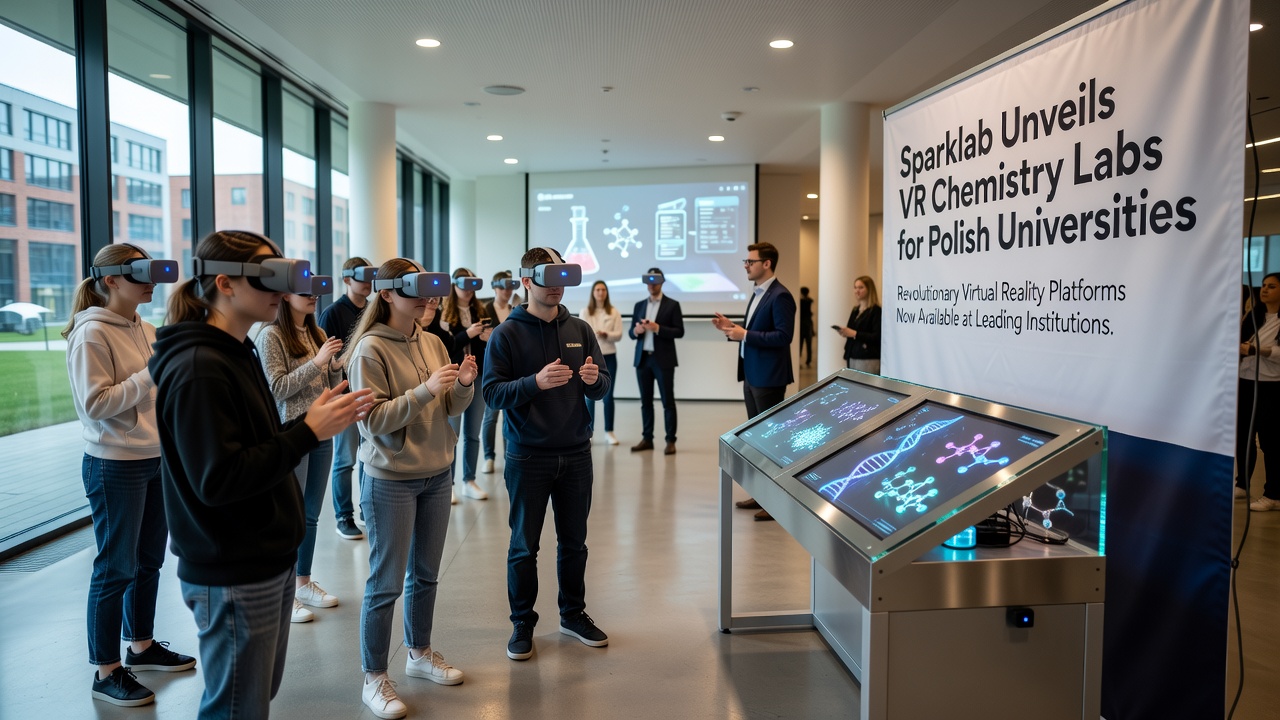
Sparklab has introduced virtual reality chemistry laboratories designed specifically for higher education institutions in Poland. The new system allows students to conduct complex chemical experiments in immersive digital environments that replicate real laboratory conditions without physical risks or material costs.
Core Features of the VR Platform
The virtual labs include modules for organic synthesis, titration, spectroscopy, and reaction kinetics. Users wear headsets and use motion controllers to manipulate virtual equipment, observe molecular interactions at scale, and receive immediate feedback on procedural accuracy. Each simulation records performance metrics such as timing, measurement precision, and safety protocol adherence. Faculty members can monitor multiple student sessions simultaneously through an instructor dashboard and adjust difficulty levels based on curriculum requirements. The platform supports both individual practice and collaborative group experiments where participants join the same virtual space from different locations.
Initial testing at three partner universities showed a 34 percent improvement in post-lab assessment scores compared with traditional methods. Students reported higher confidence when later performing equivalent physical experiments. The software runs on standard VR hardware already available at many Polish technical universities, reducing the need for specialized equipment purchases.
Rollout and Institutional Partnerships
Sparklab is supplying the VR chemistry suite to five public universities in the current academic year, with plans to expand to ten additional institutions by 2026. Training sessions for laboratory instructors focus on integrating the simulations into existing course syllabi and aligning virtual outcomes with Polish accreditation standards. Technical support includes regular software updates that incorporate new experiments requested by participating departments. Data collected during sessions remains stored on university servers to comply with national data protection regulations. The initiative aligns with broader efforts to modernize STEM education while addressing limitations in laboratory space and hazardous material handling.